


Art
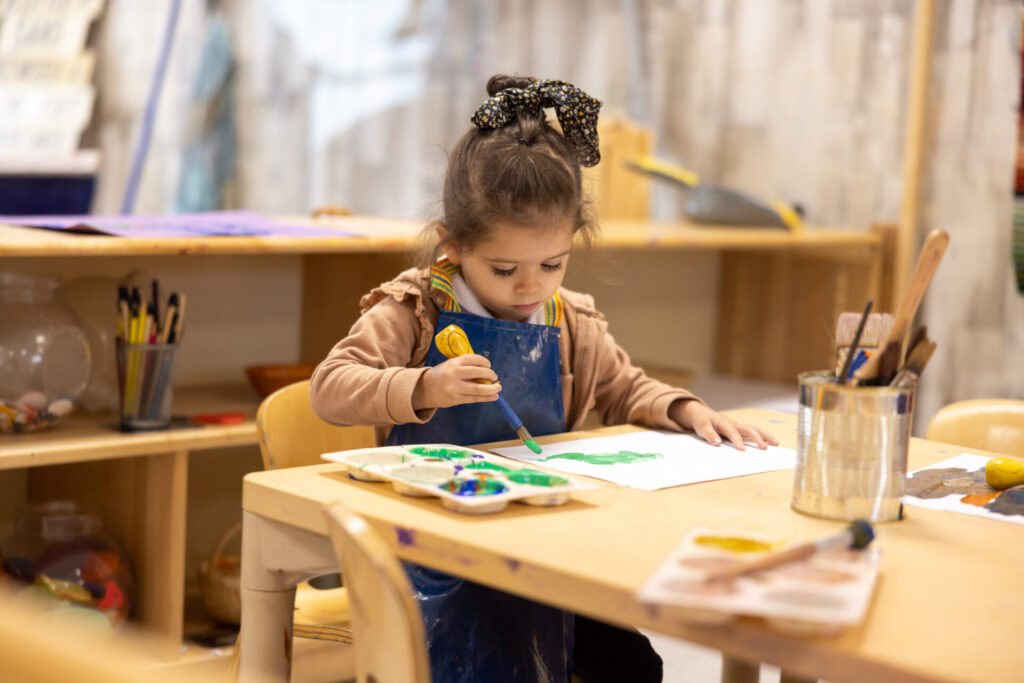
Art at Thames
We Believe…
Art is for Everyone.
Art is Unique.
Art is about expression, creativity and experimentation.
Art is cathartic and therapeutic.
Art is a window into the world, into the past, into perceptions, into possibilities.
Like us, no piece of art is the same.
We are all works of art and we are all artists.
Intent- why do we teach this?
At Thames, we take the ‘whole child’ into account. We want our pupils to leave school with excellent subject knowledge and skills, but also to leave as caring, respectful, tolerant and enthusiastic learners, who are well-equipped to become good citizens. The curriculum is designed to ensure that our children experience a wide breadth of study and have, by the end of each stage, remembered an ambitious body of substantive and disciplinary knowledge.
Implementation- What do we teach? What does this look like?
The Art and Design curriculum is designed to be taught in termly ‘themes’ right across school which will allow staff and students to share in a collective exploration of a particular art or design form for example sculpture or landscapes. Design technology will form a shadow offer, sitting underneath the Art and Design curriculum allowing for schematic knowledge to develop across the disciplines. When DT is the dominant subject, Art and Design will sit as a shadow curriculum beneath ensuring that the full range of subjects skills and knowledge is on offer at all moments and recognising that lots of the transformative competencies, skills and cognitive approaches are similar in both subjects both in substantive and disciplinary form.
The thematic approach to the curriculum offer is beneficial because it should allow for work to be gathered and “galleried/ showcased” at the end of each half term and progression in knowledge, skill and understanding should be visible from reception to year 6. Using a central thematic approach also allows for a sharing of ideas, resources and stories and creates a more interdependent and collaborative curriculum which is thoughtfully connected and visibly sequenced for mastery.
The use of a sketchbook/design book is pivotal to the delivery of these subjects as it provides a platform for creative expression – students should understand that art, design and DT are all creative processes and should be planned, explored and experimented with in a safe space. Students should know that artists and designers use sketchbooks to aid the creative process.
Impact- what will this look like?
Purposeful review and critique: talking around ideas, exploration, choice, opinion, analysis and evaluation are central to these subjects and should be visible in all of the processes of learning, as part of the discipline students should understand the value of both forming opinions and having informed opinions. (Critical evaluation and internalising personal preferences should be examined as part of the disciplinary knowledge acquired in this curriculum area).
Evidence and celebration – whilst a perfect product is not the aim, students will celebrate their creativity and have a platform to showcase their work – students will understand that part of the discipline is being original, pushing boundaries and showcasing work for appreciation or review.
Inspiration – fundamental to success in this curriculum is using inspiration from others – students will understand that taking inspiration from multiple sources including their environment, the natural world and the work of others is part of the disciplinary knowledge of this subject.
Overarching questions – every topic has an overarching question that will be explored and answered through the problem solving and creative process – as part of the development of disciplinary knowledge students will be encouraged to ask questions, take risks and find solutions.
Problem solving and planning – the process, exploration, trial and error and design journey is paramount in this curriculum and the majority of learning will be placed here. Students will know that experimentation and adaptation are key features of the disciplinary knowledge of this subject.
Design and Technology
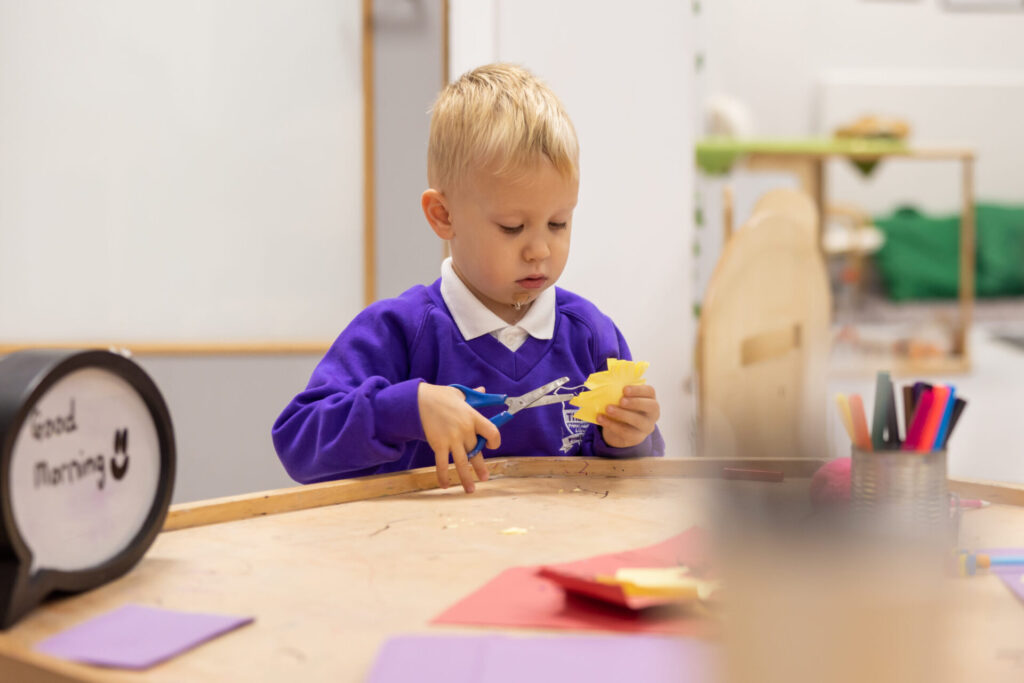
Design and Technology at Thames
Design and Technology is for everyone. Design and Technology is unique.
Design and Technology is inspiring, challenging and practical.
Design and technology is about creativity and innovation.
Design and Technology is about purposeful products for an ever changing world.
Like us, no product of Design and Technology is the same.
We are all future designers in the making.
Intent- why do we teach this?
At Thames, we take the ‘whole child’ into account. We want our pupils to leave school with excellent subject knowledge and skills, but also to leave as caring, respectful, tolerant and enthusiastic pupils, who are well-equipped to become good citizens. The curriculum is designed to ensure that our pupils experience a wide breadth of study and have, by the end of each stage, remembered an ambitious body of substantive and disciplinary knowledge. Through our DT curriculum, pupils will be inspired by engineers, designers, chefs and architects to enable them to create a range of structures, mechanisms and food products with a real life purpose.
Implementation- What do we teach? What does this look like?
The Design and Technology curriculum is designed to be taught in termly ‘themes’ right across school which will allow staff and pupils to share in a collective exploration of a particular design form, for example mechanisms or structures. Design technology will form a shadow offer, sitting in tandem with the Art and Design curriculum allowing for schematic knowledge to develop across the disciplines. When DT is the dominant subject, Art and Design will sit as a shadow curriculum beneath ensuring that the full range of subjects skills and knowledge is on offer at all moments and recognising that lots of the transformative competencies, skills and cognitive approaches are similar in both subjects both in substantive and disciplinary form.
The thematic approach to the curriculum offer is beneficial because it should allow for work to be gathered and “galleried/ showcased” at the end of each half term and progression in knowledge, skill and understanding should be visible from reception to year 6. Using a central thematic approach also allows for a sharing of ideas, resources and stories and creates a more interdependent and collaborative curriculum which is thoughtfully connected and visibly sequenced for mastery.
All teaching of DT follows the design, make and evaluate cycle. Each unit is rooted in knowledge, techniques and processes. The design process is linked to real life, alongside relevant contexts that give meaning to learning. While designing and creating, pupils are given choice and a range of tools to choose freely from. To evaluate, pupils are able to evaluate their own products against a design criteria, working in collaboration with their peers.
The use of a sketchbook is pivotal to the delivery of these subjects as it provides a platform for creative expression – pupils should understand that DT and art and design are all creative processes and should be planned, explored and experimented with in a safe space. pupils should know that designers and artists use sketchbooks to aid the creative process.
Impact- what will this look like?
Purposeful review and critique: talking around ideas, exploration, choice, opinion, analysis and evaluation are central to these subjects and should be visible in all of the processes of learning, as part of the discipline pupils should understand the value of both forming opinions and having informed opinions. (Critical evaluation and internalising personal preferences should be examined as part of the disciplinary knowledge acquired in this curriculum area).
Evidence and celebration – whilst a perfect product is not the aim, pupils will celebrate their creativity and have a platform to showcase their work – pupils will understand that part of the discipline is being original, pushing boundaries and showcasing work for appreciation or review.
Inspiration – fundamental to success in this curriculum is using inspiration from others – pupils will understand that taking inspiration from multiple sources including their environment, the natural world and the work of others is part of the disciplinary knowledge of this subject.
Overarching questions – every topic has an overarching question that will be explored and answered through the problem solving and creative process – as part of the development of disciplinary knowledge pupils will be encouraged to ask questions, take risks and find solutions.
Problem solving and planning – the process, exploration, trial and error and design journey is paramount in this curriculum and the majority of learning will be placed here. pupils will know that experimentation and adaptation are key features of the disciplinary knowledge of this subject.
Computing
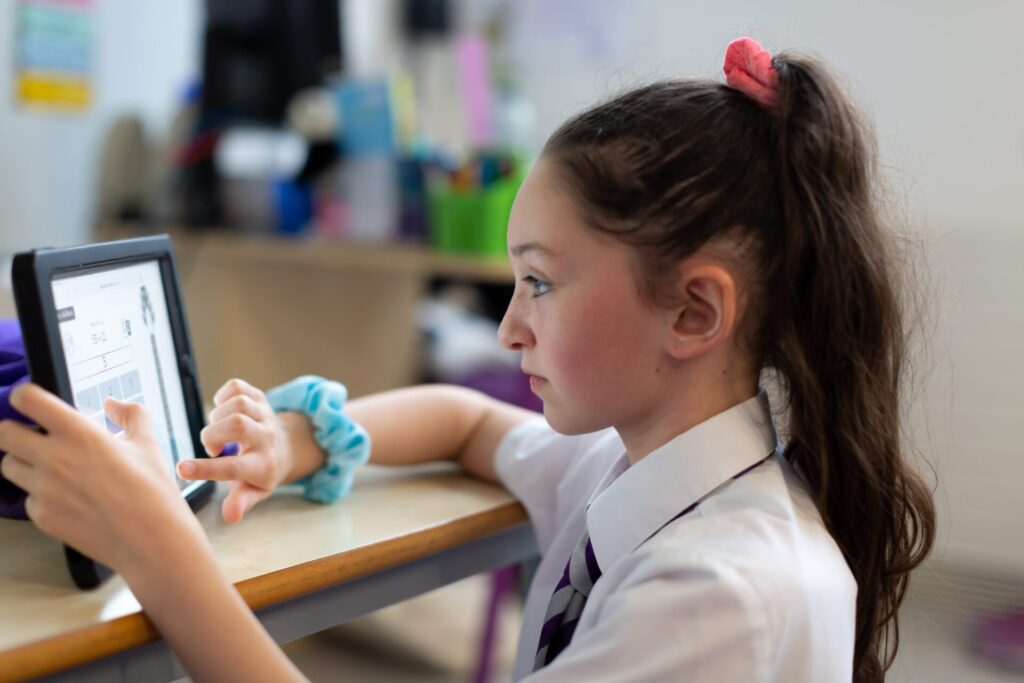
Computing at Thames
“Computers are incredibly fast, accurate and stupid: humans are incredibly slow, inaccurate and brilliant; together they are powerful beyond imagination.” – Albert Einstein
Intent- why do we teach this?
We enable our children to responsibly communicate, creatively collaborate and articulate their ideas, their thoughts and their feelings through the use of a broad range of digital technologies
We encourage our children to develop their understanding of themselves as individuals within their online communities. We provide opportunities for our children to be active participants that safely flourish in the wider global community – enabling our children, regardless of their background, abilities and needs to unlock the wonders of the world at their fingertips.
We embrace and utilise digital technology to expose our children to a world of endless opportunities and possibilities through every aspect of our curriculum. We encourage our children to be autonomous and confident users of technology, providing them with the tools that will equip them for an ever changing digital world, opening up the pathway to tomorrow.
Implementation- What do we teach? What does this look like?
At Thames Primary we believe that computing will play a pivotal role in the lives of our children for today and tomorrow. We therefore aim to offer a broad, balanced and ambitious curriculum that ensures that all of our children access a curriculum that fosters a personalised learning approach that is designed and implemented in an ethical, inclusive and equitable manner.
We have built our curriculum around four Knowledge Concepts, which are: Communicate, Code, Collect and Connect.
We recognise that technology can allow children to Communicate their learning in creative ways. Teaching our children the language of Code which is behind everything we see on a computer, empowering them to be programmers of the future. The opportunity to Collect enables children to ask and answer relevant questions and evaluate outcomes. We also understand the need to Connect our children with the wider digital community.
Impact- what will this look like?
As a result of having received a Computing Curriculum at Thames Primary Academy our children are digitally literate and prepared for their future workplace and to be active citizens in a digital world. Our children begin to access the Computing Curriculum in Nursery and this progresses to Year 6, which is in line with the National curriculum requirements (2014).
Children from Year 2 to Year 6 have access to their own Chromebook. Reception and Year 1 have access to a class set of touch screen Chromebooks, which are more suited to their development and skills. As a Google Reference School for Education we have aligned a Digital Skills shadow curriculum, which runs alongside the Computing Curriculum – enabling children to become literate with Chromebook functionality and Google Workspace, which in turn supports the delivery and implementation of the Computing Curriculum. Children have a firm grasp on how to be safe, respectful and responsible when using digital devices and their associated programs. This is evidenced through the collection of a range of work samples, whole school initiatives, Digital Skills Passports and when appropriate in other forms. This is further evident in our children’s ability to use their developed vocabulary to express themselves and develop their ideas through information and communication technology. Problem solving and planning – the process, exploration, trial and error and design journey is paramount in this curriculum and the majority of learning will be placed here. pupils will know that experimentation and adaptation are key features of the disciplinary knowledge of this subject.
English
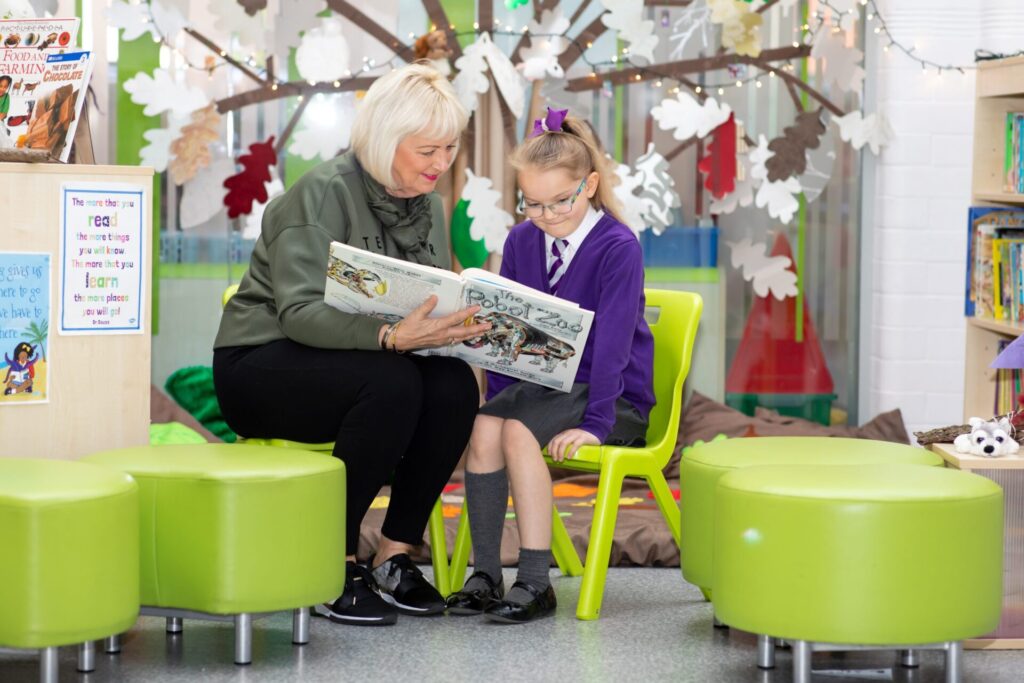
English at Thames
Curriculum Intent
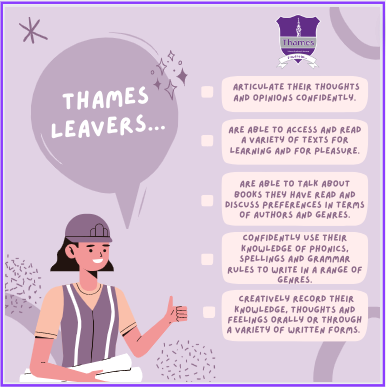
Our English curriculum develops children’s spoken language, reading, writing, grammar and vocabulary. The skills of English are taught in discreet English lessons which are then applied and practised in a cross curricular approach, linking up and making connections across subjects.
Speaking and listening
Our children are taught in a language rich environment, where they are encouraged to speak clearly and with confidence, conveying their views and ideas fluently using an ever growing vocabulary. An emphasis on the teaching of vocabulary and developing oracy skills places speaking and listening at the heart of our whole school curriculum. Time to talk is embedded as an integral part of every lesson, every day.
Phonics at Thames
All staff at Thames have been trained to deliver systematic phonic instruction using the DfE approved Read, Write Inc programme.
Every day, children learn new sounds, and review previous sounds and words. They apply what they’ve been taught by reading words containing the sounds they know in matched decodable books and other texts, and write these sounds in individual words and, later, sentences. Children from Nursery through to Year 2 are taught Phonics in small, differentiated groups on a daily basis. The groups take account of the ‘age and stage’ of the child’s phonics development and their learning styles. These groups are reassessed half termly to maximise the progress of every child. Teachers also ensure they embed learning from discrete phonics sessions within their English lessons and across the wider curriculum. Children in KS2 who still require phonics support are taught in small groups or in 1-1 sessions as appropriate.
Reading
The teaching of reading is systematic and sequential across school. We recognise the importance of ‘being able to read and comprehend’ as being central to accessing all other areas of the curriculum and the world around them. We read with and to children through a wide range of independent, shared, guided and class reading activities in order to develop children who ‘are readers’ rather than ‘read’. Children have access to a wealth of carefully selected books of all genres through their individual class libraries, outdoor library areas and shared key stage library.
Writing
We develop writing skills, including grammar, punctuation and spelling knowledge, so that our children have the skills, knowledge, stamina and motivation to write, in a range of genres and for different purposes, at an age appropriate standard. Effective composition involves forming, articulating and communicating ideas, and then organising them coherently for a reader. At Thames we understand that real writers read. In order for our children to become authors, we encourage them to think like authors at every opportunity within the English curriculum; this happens through well-thought out questioning, meaningful class discussions and purposeful analysis of texts across a wide range of genres. Through our English Curriculum children are exposed to texts that are at their reading level but also a range of aspirational texts.
Our curriculum is based around a non fiction into fiction approach. Every half term a non -fiction is the focus of the first unit, this enables the children to gather knowledge and vocabulary that they can then apply in the following fiction unit. Within our sequence of lessons we expose the children to a variety of writing models to allow the children to understand the process of writing.
We teach vocabulary explicitly during English lessons, providing easy-to-understand definitions, examples and non-examples of the target word, opportunities for discussion; staff will then check for understanding. Children are then given the opportunity to practise using new vocabulary within the English lesson and across the curriculum.
Handwriting, spelling and grammar and punctuation lessons are taught discreetly, planned and linked carefully to the specific unit of writing and then applied through independent writing, both in English lessons and across the curriculum.
Children are taught in mixed ability classes and intervention programmes such as Fresh Start, Toe by Toe and Rapid Writing are used for those children who need additional support. The focus is on early intervention so that an additional need can be identified and supported.
English is celebrated and promoted across the school with events and extracurricular activities such as World Book Day, reading challenges, poetry and choral speaking competitions, 500 word story challenge, visiting authors and poets.
Geography
Geography at Thames
“Geography is the study of earth as the home of people”
Intent- why do we teach this?
We enable our children to responsibly communicate, creatively collaborate and articulate their ideas, their thoughts and their feelings through the use of a broad range of digital technologies
We encourage our children to develop their understanding of themselves as individuals within their online communities. We provide opportunities for our children to be active participants that safely flourish in the wider global community – enabling our children, regardless of their background, abilities and needs to unlock the wonders of the world at their fingertips.
We embrace and utilise digital technology to expose our children to a world of endless opportunities and possibilities through every aspect of our curriculum. We encourage our children to be autonomous and confident users of technology, providing them with the tools that will equip them for an ever changing digital world, opening up the pathway to tomorrow.
Implementation- What do we teach? What does this look like?
At Thames Primary we believe that computing will play a pivotal role in the lives of our children for today and tomorrow. We therefore aim to offer a broad, balanced and ambitious curriculum that ensures that all of our children access a curriculum that fosters a personalised learning approach that is designed and implemented in an ethical, inclusive and equitable manner.
We have built our curriculum around four Knowledge Concepts, which are: Communicate, Code, Collect and Connect.
We recognise that technology can allow children to Communicate their learning in creative ways. Teaching our children the language of Code which is behind everything we see on a computer, empowering them to be programmers of the future. The opportunity to Collect enables children to ask and answer relevant questions and evaluate outcomes. We also understand the need to Connect our children with the wider digital community.
Impact- what will this look like?
As a result of having received a Computing Curriculum at Thames Primary Academy our children are digitally literate and prepared for their future workplace and to be active citizens in a digital world. Our children begin to access the Computing Curriculum in Nursery and this progresses to Year 6, which is in line with the National curriculum requirements (2014).
Children from Year 2 to Year 6 have access to their own Chromebook. Reception and Year 1 have access to a class set of touch screen Chromebooks, which are more suited to their development and skills. As a Google Reference School for Education we have aligned a Digital Skills shadow curriculum, which runs alongside the Computing Curriculum – enabling children to become literate with Chromebook functionality and Google Workspace, which in turn supports the delivery and implementation of the Computing Curriculum. Children have a firm grasp on how to be safe, respectful and responsible when using digital devices and their associated programs. This is evidenced through the collection of a range of work samples, whole school initiatives, Digital Skills Passports and when appropriate in other forms. This is further evident in our children’s ability to use their developed vocabulary to express themselves and develop their ideas through information and communication technology.
History
History at Thames
“The more you know about the past, the better prepared you are for the future”
Theodore Roosevelt
Intent- why do we teach this?
At Thames Primary Academy, we want children to have a strong connection to their local, national and international history. We aim to deliver a curriculum that reflects these connections, diving deep into the knowledge of different eras, people and places. We aim to provide the children with a rich variety of learning opportunities that are meaningful and valuable to their understanding of their local and global community through time.
Our History curriculum seeks to provide children with a strong and confident understanding of the UK, as well as the development of other countries from ancient times to more recent history. It is a curriculum that develops the children’s thirst for knowledge and motivates their learning. The curriculum is deliberately not taught in “chronological” order in an attempt to build the skills within students of creating timelines and understanding that periods and civilisations overlap.
The History curriculum at Thames mirrors the design concept of the Geography curriculum – starting local in terms of time and place with a historical investigation of the school, the local community and the period in which the school was built and then scaling up. In Geography the core ideas are ideas of scale and place and in history this is about time. There is also some knowledge connectivity between the history and geography content to maximise the schema of students.
Links to Whole School Drivers
- Community – drawing on our local area and the people in it as a primary historical source, building a strong sense of place and change over time.
- Possibilities- looking at historical figures and significant events through time, exposing pupils to others lives in order to reflect on how they might impact on the world in their own life time.
- Communication- pupils will have consistent opportunities to review, reflect and share their historical understanding through a rich, shared dialogue.
- Healthy Advocates- what can we learn about keeping healthy, both in body and mind from lessons from the past?
We aspire to develop our children’s vocabulary, knowledge, oracy and understanding of their history. We support them in understanding the past as they move into the future, developing them into confident and understanding citizens. We also want to develop our children’s awareness of diversity throughout history, both within our national history but also the international history of other countries and cultures. We hope that this will make our children aware of the racial inequality throughout the world’s history.
The evolution of every pupil as a historian runs throughout our curriculum, specifically the development of the skills of being a historian; gathering evidence, examining artefacts, using primary and secondary sources and undertaking research.
Implementation- What do we teach? What does this look like?
At Thames Primary Academy, our staff are supported in their teaching and planning by our subject leaders to ensure that progress is consistent in the children’s History learning. There is a strong commitment to knowledge and skills that are passed onto the children in a variety of contexts and situations.
We follow a core knowledge curriculum, which has created a methodical sequence for children to build on their knowledge year by year as they move through the school. As children learn new vocabulary, facts and figures, these will be recapped in later years to consolidate learning as our history is linked in many ways.
Alongside this knowledge, we also teach our children to be historians and how to study the past. We focus on comparing past eras to what we know today, examining artefacts and understanding what they can teach us about the culture and lives of people in history and how to ask probing questions to extend our knowledge and unpick more of our history.
We hope to form strong, powerful links with our local history community, embedding this in our curriculum to provide new and exciting learning opportunities. We will utilise our local facilities and sites to support children’s learning and memory of key aspects of different historical eras, using these in real life settings. This may involve visits to local historical sites e.g. Blackpool Tower to learn of its origins, as well as Fleetwood Museum to learn about how our area has developed from its origins to the present day.
Our History curriculum provides a wide breadth of study, incorporating all the content of the National Curriculum. It is carefully designed and sequenced to ensure a clear progression in the development of knowledge and skills to maximise learning for all pupils.
It is essential that as pupils learn, they will develop a history schema which is organised in a meaningful way so that they learn and remember more. They are encouraged to make connections in their learning through the knowledge that they are taught. Through every topic, pupils will explore the big ideas or the threshold concepts which will form the foundations of the schema. These threshold concepts are:
- Investigate and interpret the past – This concept involves recognising that our understanding of the past comes from an interpretation of the available evidence.
- Build an overview of world history – This concept involves an appreciation of the characteristic features of the past and that these features are similar and different across time periods, and an understanding that life is different for different sections of society.
- Understand chronology – This concept involves an understanding of how to chart the passing of time and how some aspects of history happened at similar times in different places.
- Communicate historically – This concept involves using historical vocabulary and techniques to convey information about the past.
Each threshold concept has its own facets of knowledge which help to strengthen the schema. These knowledge categories include:
Settlements
Beliefs
Culture and pastimes
Location
Main events
Food and farming
Travel and exploration
Conflict
Society
Artefacts
Making connections and highlighting them throughout the teaching of the breadth to help the knowledge to ‘stick’ in the pupil’s memory is a crucial part of learning. We use retrieval practice to aid pupils in storing knowledge in their long-term memories. We endeavour to build knowledge with an awareness of cognitive loads, and so we start from what children already know, and build on this using a carefully planned progression. Lessons and new topics begin with a review of prior learning to support pupils in assimilating new knowledge with previously introduced concepts.
We encourage parents and members of the community to share their knowledge and experiences of the local area and wider world with pupils. We share where members of our community have been, and where we are going on a large scale world map to encourage conversation about the wider world, and an appreciation of the value of a broad geographical knowledge.
We ensure all pupils can access our teaching by planning support for those that need it in the form of differentiated resources or additional teacher support.
Impact- what will this look like?
Our children’s accumulated historical knowledge will be assessed regularly at the end of the era or period they are learning about. This may take the form of quizzes linked to the core knowledge in each era, or an investigation as a historian with historical artefacts or images. Other frequent retrieval opportunites will be woven throughout the learning using mini plenaries, key assessment questioning and recaps.
Our children leave our school confident in their knowledge of many aspects of History, as well as understanding the progression of time and chronology. This will allow them to have a strong understanding of their wider community.
Maths
Maths at Thames
“Good Mathematics is not about how many answers you know… It’s about how you behave when you don’t know.”
At Thames, we stress the importance of an agreed, whole school approach to the teaching of mathematics, of which staff, children, parents and governors have a clear understanding. It reflects the essential part that mathematics plays in the education of all pupils.
Intent
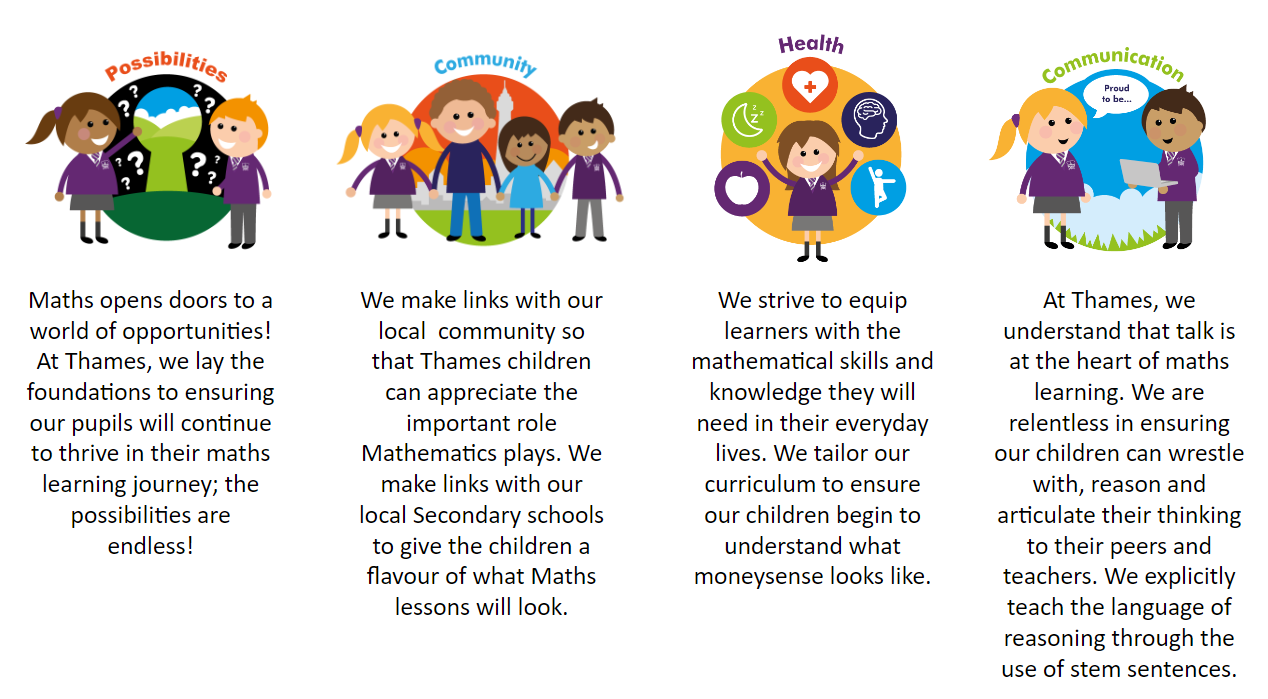
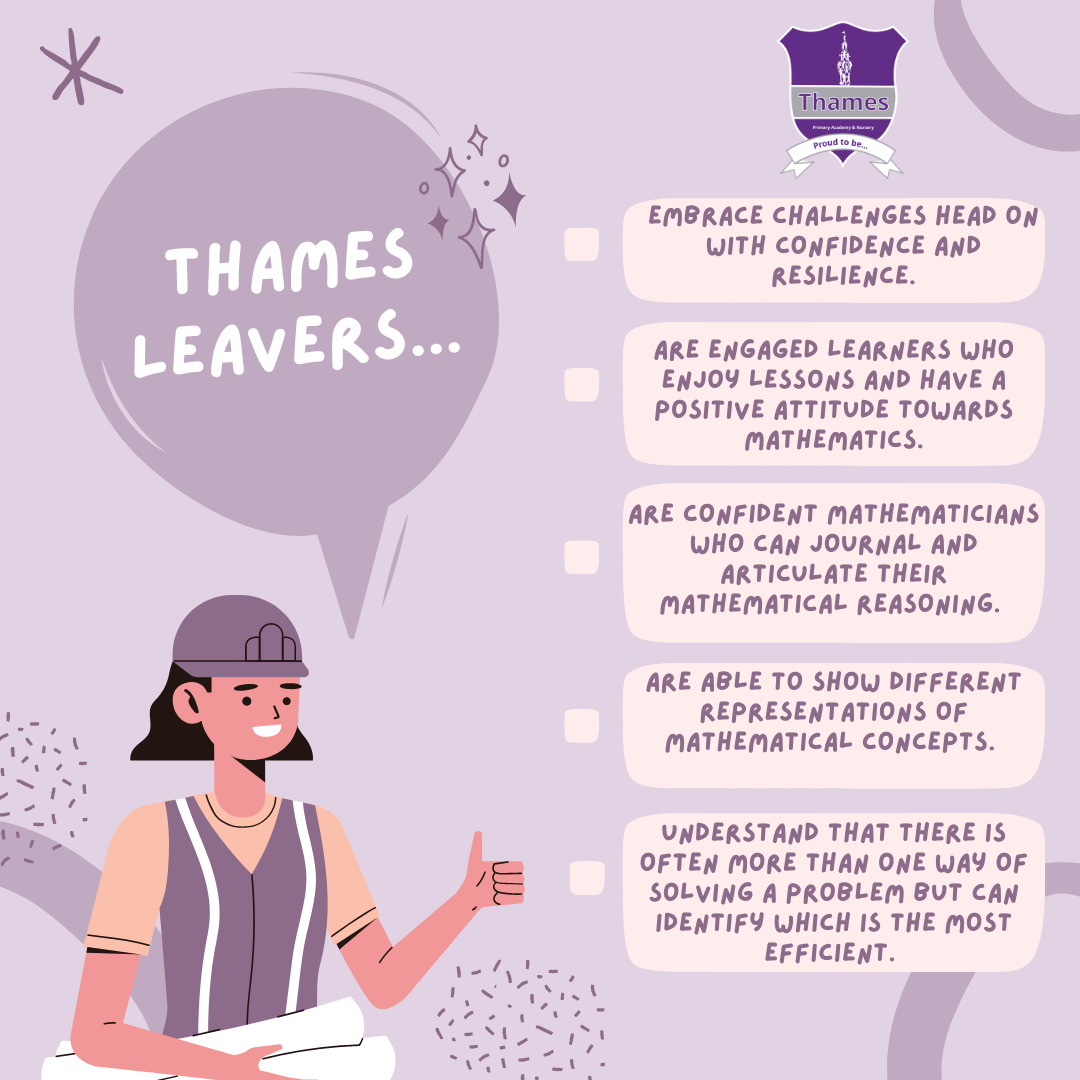
We strive to empower children with the knowledge, skills and understanding to become confident mathematical thinkers and problem solvers. We aim to be ambitious and appreciate the beauty and power of mathematics.
Everyone is a mathematician at Thames Primary Academy.
The 2014 National Curriculum for Mathematics aims to ensure that all children:become fluent in the
- fundamentals of mathematics
- are able to reason mathematically
- can solve problems by applying their mathematics.
At Thames Primary Academy, we aim to ensure that our Mathematics curriculum is fully inclusive of every child, empowering everyone to enjoy and experience success in order to develop a positive and confident attitude towards mathematics.
We support children to recognise the importance of mathematics in the wider world and use and apply their mathematical ability to make appropriate choices in real-life situations.
Implementation
Our Mathematics Curriculum seeks to ensure that every child becomes confidently numerate as they progress through school. Lesson sequences are planned in small steps so that knowledge is taught in relation to all of our children’s cognitive loads and is built cumulatively over time. Time is spent ensuring children understand and develop the correct mathematical vocabulary; this enables our children to develop logical thinking in order to solve problems and record in a systematic way; use maths to interpret, predict, explain their thinking and strategies they have used and be able to reason mathematically.
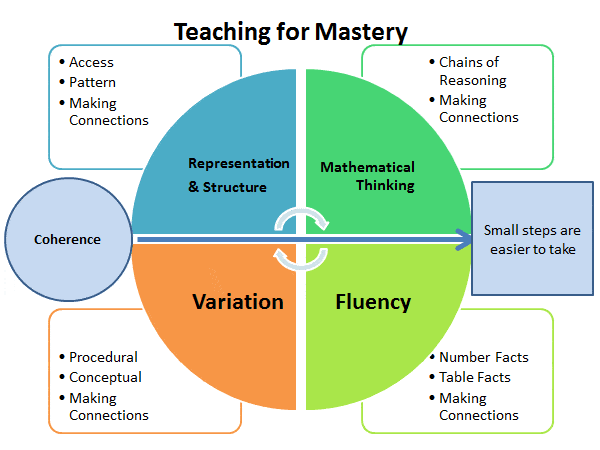
Here at Thames, we have implemented a maths mastery approach to teaching that gives pupils a deep, long-term, secure and adaptable understanding of mathematics. Our maths mastery curriculum is underpinned by the five big ideas as illustrated.
Our mastery approach rejects the idea that only some children can do well in maths. We embrace the idea that everyone can do well, regardless of prior attainment. Teaching maths for mastery offers all pupils access to the full maths curriculum. With a mastery approach, the whole class moves through topics at broadly the same pace. Each topic is studied in depth and the teacher doesn’t move to the next stage until all children demonstrate a secure understanding of mathematical concepts.
To ensure whole school consistency and progression, we use the DfE approved Maths No Problem Scheme as a basis for our sequencing and planning of lessons; this ensures that there is a detailed, structured curriculum mapped out across all phases, ensuring continuity and consistency in our approach.
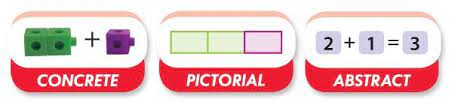
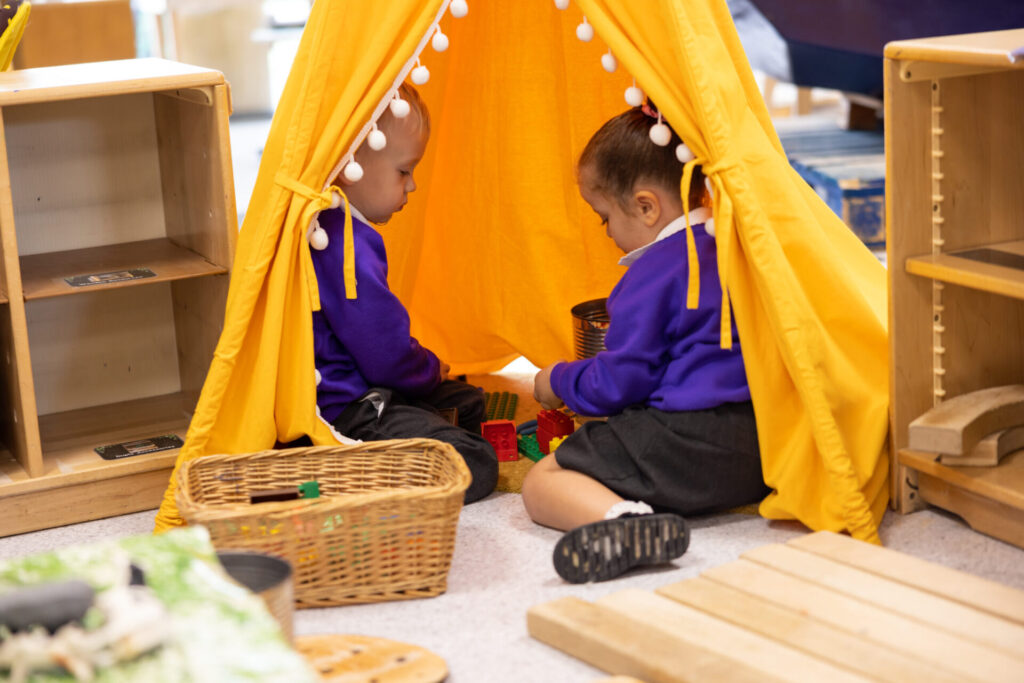
Children acquire fluency of skills by introducing concepts in a practical/concrete way , then progressing to pictorial and eventually abstract methods (C-P-A).
Daily Maths Lessons in KS1 and KS2
Predominantly, teachers plan from the Maths No Problem scheme of learning which expertly breaks large concepts of learning into smaller, manageable steps which build upon each other to promote a greater depth of understanding. Planning is also supported by resources from Third Space Learning, White Rose Maths, Gareth Metcalfe and the NCETM resources.
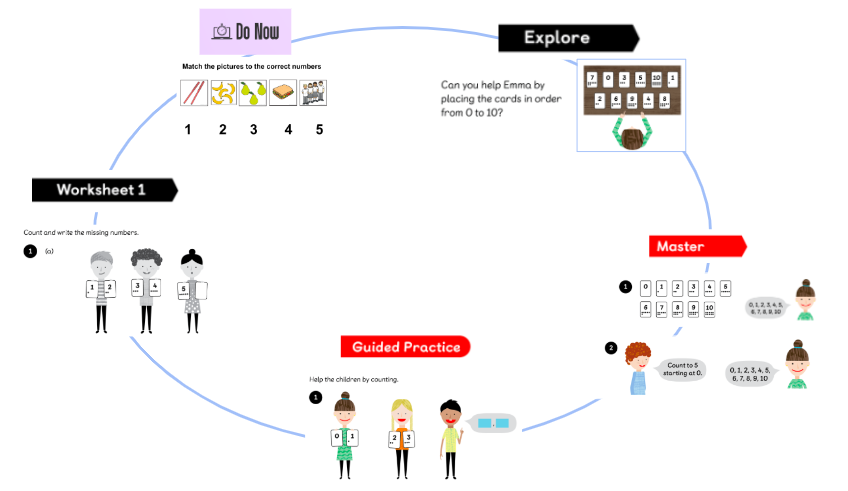
A typical maths lesson lasts approximately 1 hour and is taught daily. Children begin the lesson with a quick ‘Do Now’ task which supports fluency and recall of number facts that are pertinent to the upcoming lesson.
Following this, the main part of the lesson begins with an ‘Explore’ task; a contextual problem is shared for the children to discuss and delve into in their maths journals. This helps promote discussion and reasoning and ensures mathematical ideas are introduced in a logical way to support conceptual understanding. During the ‘Master’ part of the lesson, the teacher demonstrates the varying strategies that could be used to solve the problem and they use careful and considered questions to draw out children’s discussion and their reasoning of the problem.
Following this, the children are presented with similar problems during the ‘Guided Practice’ section of the lesson where the children can choose to use the scaffolds provided by the teacher should they wish to solve the problems. Teachers use this part of the lesson to address any initial errors or misconceptions as well as reminding and cementing the different methods that can be used in preparation for the children to succeed independently. The class then progresses to their independent practice part of the lesson, working in their workbooks, using their journals, working walls and concrete materials to support if necessary. This practice uses conceptual and procedural variation to build fluency and develop greater understanding of underlying mathematical concepts. For children who finish their independent practice work, appropriate challenge(s) is provided which promotes a deeper level of thinking around the same concept.
In order to strengthen the connections of the material learned, teachers skillfully create ‘Morning Maths Mats’ for the children to complete during open school before registration. This gives the children an opportunity to apply and practise the skills that they have recently learned in maths lessons, or begin to recall information from previously taught units in preparation for the unit being taught again. This daily practice supports the process of building up the amount of effective practice required to reach the level of mastery where recall is automatic.
In addition to the daily hour of maths, each class receives an additional 30 minute fluency and arithmetic practice as we recognise that children must have the fundamental and foundational building blocks on which to build their mathematical knowledge. During this session, teachers and support staff may also use a variety of strategies to target children who may need some extra support; this may be in the form of a pre-teach for the next lesson or a targeted intervention based on the lesson that morning. Teachers and support staff are skilled at being able to recognise when intervention is needed and choosing the appropriate way in which to do this.
Maths in the Early Years
Developing a strong grounding in understanding number is essential so that all children develop the necessary building blocks to excel mathematically. Within our Early Years we strive to ensure our children are provided with rich opportunities to develop their spatial reasoning skills across all areas of mathematics including shape, space and measures. Our focus is to ensure that all children develop firm mathematical foundations in a way that is engaging and appropriate.
The six key areas of our early mathematical learning are:
Cardinality and Counting- Understanding that the cardinal value of a number refers to the quantity
Comparison- Understanding that comparing numbers involves knowing which numbers are worth more or less than each other
Composition- Understanding that one number can be made up from two or more smaller numbers
Pattern- Looking for and finding patterns helps children notice and understand mathematical relationships
Shape and Space- Understanding what happens when shapes move, or combine with other shapes, helps develop wider mathematical thinking
Measures- Comparing different aspects such as length, weight and volume, as a preliminary to using units to compare later.
In Early Years, pupils are taught in accordance with the EYFS framework- children receive:
Engaging and exciting adult-led learning opportunities
Opportunities to learn and develop through play- ensuring continuous provision promotes mathematical development and provides children with ‘real life’ mathematical experiences
Frequent and varied opportunities to build and apply mathematical understanding
Individual assessments and next steps, which are implemented through the use of effective mathematical learning trajectories
Mathematical learning through play in the Early Years:
Children are encouraged to develop positive attitudes and interests in mathematics through high quality interactions and support from adults, promoting a sense of curiosity.
- The children within our Early Years are presented with opportunities to develop their mathematical understanding within their environment and are provided with meaningful scaffolding and resources that build on their interests and intuitive mathematical knowledge. Mathematical opportunities are presented within:
- Story time
- Song time
- Sand and water play
- Small world play
- Construction play
- Role play
- Mark-making and creative play
- Outdoor learning environment
- Physical activities
- Games
- Circle time
- ICT
- Routines
- A playful learning approach within our Early Years, offers the opportunity to deliver rich mathematical learning through child-directed and adult-supported play.
Mastering Number Programme
From Reception, through to Years 1 and 2 , we provide an additional 15 minutes of Maths each day through the NCETM’s Mastering Number Programme. The aim is that children will leave KS1 with fluency in calculation and a confidence and flexibility with number.
Intervention
Through monitoring and formative assessment, pupils who may struggle or possibly ‘fall behind’ with parts of the curriculum are quickly identified. Teachers work closely with support staff to initiate the best action to support struggling learners. As well as extra support being provided for the main part of the lesson, it may be necessary to plan extra intervention sessions to close the attainment gap. For targeted SEND pupils, an adapted, personalised curriculum is considered. Interventions include:
- In class support
- Pre teach
- Small group, maths booster lessons led by trained teaching assistants
- After school tuition
Assessment and Marking
During lessons, teachers use Assertive Monitoring to accurately assess children and provide focus and relevant feedback. Assertive Monitoring establishes what a child can do and what they need to do to move to the next stage of learning. Assertive monitoring may also be used to inform next steps and support interventions for children who have not grasped a concept.
Children’s independent work will always be marked by a member of staff using green and orange highlighters or it will be self-marked by the child. This is paramount as immediate feedback ensures that children have time in the lesson to reflect and act on feedback. Mistakes are corrected with a purple polishing pen.
At the end of each unit taught, a Workbook Review is completed by the children which assesses which parts of the unit each child has grasped and which elements they need more support with. Teachers use this information to identify any children who need additional support to master the concepts within the unit.
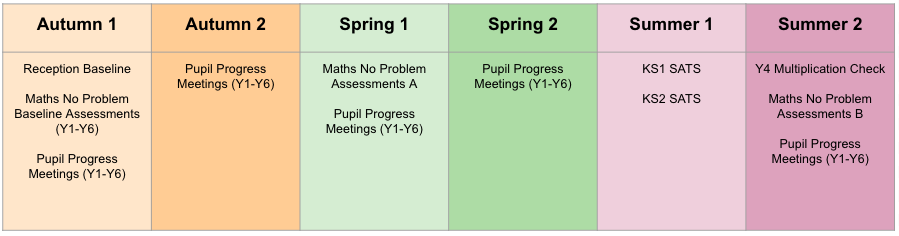
Timely summative assessments are undertaken throughout the year to assess long-term progress; the results are tracked using the Maths No Problem tracking programme, Insights. Children are recorded as working towards, expected or greater depth. This data is then analysed in half-termly pupil progress meetings to ensure the attainment gap is being closed and that children are being adequately supported in lessons.
The assessment timetable is shown below:
In Early Years, pupils are assessed against the Early Years Foundation Profile and are awarded levels of Emerging, Expected and Exceeding, matched to their achievement of the assessed statements.
Impact
Performance Indicators, which are the criteria for the success of the school’s mathematics policy, are:
Early Years Foundation Profile (Statutory Assessment)
Maths No Problem Assessments
KS1 results (Statutory Assessment)
KS2 results (Statutory Assessment)
Months No Problem Insights Data tracking
Pupil voice
Modern Foreign Languages
Modern Foreign Languages at Thames
“To learn a language is to have one more window from which to look at the world”
Chinese proverb
Intent- why do we teach this?
At Thames Primary, we believe that learning a foreign language is an essential part of a well-rounded education. Our MFL curriculum is designed to inspire and empower our pupils to become confident and effective communicators in a globalised world.
- Broadening Horizons: Our MFL curriculum aims to broaden the horizons of our students by exposing them to different cultures and languages. We want our students to develop an appreciation and understanding of diverse perspectives, fostering open-mindedness and tolerance and celebrating difference.
- Communication Skills: We strive to develop our students’ ability to communicate effectively in a foreign language. Through engaging activities, interactive discussions, and real-life scenarios, we enable them to express themselves, both orally and in writing, with confidence and fluency.
- Cultural Awareness: Our MFL curriculum places a strong emphasis on cultural awareness and understanding of all who live in the local community. We aim to deepen our students’ knowledge of different cultures, traditions, customs, and celebrations. By exploring cultural aspects alongside language learning, we encourage our students to become global citizens who respect and appreciate cultural diversity.
- Enthusiasm for Languages: We aspire to instil a love for languages in our pupils. By making language learning enjoyable and interactive, we want our pupils to develop a lifelong enthusiasm for exploring new languages and cultures, widening their perception of the possibilities open to them for travel and exploration in their life. We celebrate their progress and achievements, fostering a positive and encouraging learning environment.
- Progression and Continuity: Our MFL curriculum is carefully planned to ensure progression and continuity throughout the years. We build upon prior knowledge and skills, enabling our pupils to develop a solid foundation in the target language. We endeavour to set them up for success in their future language learning journey at high school and beyond.
Implementation- What do we teach? What does this look like?
- Engaging Lessons: Our MFL lessons are designed to be interactive, engaging, and inclusive. We use a variety of teaching strategies, including singing, role play, games, multimedia resources, and authentic materials, to enhance pupils’ learning experiences and encourage all pupils to participate.
- Language Skills Development: We focus on the development of all four language skills: listening, speaking, reading, and writing. Our curriculum provides opportunities for students to practise these skills through group activities, paired discussions, reading comprehension exercises, and written tasks.
- Cultural Immersion: We believe that cultural immersion is key to language learning. Through cultural projects, festivals, international celebrations, and virtual exchanges, we expose our students to the richness and diversity of the target language culture, fostering a deeper understanding and appreciation.
- Technology Integration: We embrace technology as a tool to enhance language learning. Our students have access to language learning platforms, online resources and interactive apps, enabling them to practise their language skills.
Impact- what will this look like?
Regular assessment and feedback play a crucial role in our MFL curriculum. We use a variety of assessment methods, including oral presentations, written assignments, listening exercises, and quizzes. Through personalised feedback, we guide our pupils towards improvement and celebrate their progress.
At Thames Primary Academy, we are committed to providing our pupils with a high-quality MFL education that equips them with the necessary skills and knowledge to navigate an increasingly interconnected world. We believe that learning a foreign language is not just about acquiring vocabulary and grammar, but also about fostering empathy, curiosity, and a global perspective. We hope to inspire the children to begin an exciting linguistic and cultural journey.
Music
Music at Thames
“Music education can spark a child’s imagination or ignite a lifetime of passion.”
“Music education should not be a privilege for a lucky few, it should be part of every child’s world of possibility.” – Hilary Clinton
Intent- why do we teach this?
At Thames Primary Academy, all pupils have access to an inclusive music curriculum which aims to engage our whole community and promote a love of music. They are exposed to a wide variety of musical and cultural traditions to promote the development of pupils’ spiritual, moral, social and cultural development. We explicitly teach pupils the key areas of music: dynamics, rhythm, melody, pitch and tempo. This helps them to think critically about what they are listening to and develop their evaluation skills – explaining their opinions clearly and concisely. Through performing on vocals, percussion and tuned instruments, pupils develop their self-confidence and they see the power of communication through the media of music. They are able to develop their creativity using the key skills they have identified in the work of others to inspire their own work. In lessons, pupils are introduced to the key vocabulary needed to discuss music and listen carefully and considerately to the views of others. Through exploring playing a range of instruments they will be exposed to the possibilities available to them should they decide to pursue taking on the commitment of learning an instrument. They will develop the resilience needed to keep going when introduced to a challenging new concept and we will commit to encouraging regular practice. Our aim for all pupils is that they can discuss their opinions around music, listen to the opinions of others and show their unique talents through performance and composition. Research has found that music has the power to increase memory and retention as well as maximising learning capabilities. Music can trigger emotions, memories and thoughts which can often lead to a positive effect on our mental well-being.
Implementation- What do we teach? What does this look like?
The implementation of the music curriculum is sequential, building on the prior skills and knowledge of pupils systematically to develop a long-term change in memory.
Alongside the taught lessons, we strive to thread music through our daily school life, increasing exposure to a broad range of genres. There is a weekly focus on a specific genre, with specially selected music for pupils to listen to when entering classrooms and assemblies. The music focus board provides information and questions to stimulate discussion and opinion. We endeavour to invite musicians into school to perform for the children and to share their own musical journey, which we hope may inspire our pupils to be musicians of the future. Our ‘singing assemblies’ facilitate the collective singing experience and allow for each class or year group to perform songs from their music lessons for the whole school to enjoy. The school year is peppered with performances from various year groups, creating a real sense of pride when showcasing to parents and the wider local community.
Early Years Foundation Stage
In the Early Years, pupils are introduced to music, rhyme and song through familiar works including nursery rhyme and song. They sing together, including with actions, on a daily basis, developing a love of music and a basic understanding of beat and melody. They explore playing untuned percussion instruments and they experience performing for an audience.
Key Stage One
During this key stage, children are introduced to all the key elements of music. They begin to study important works in the musical canon, with a focus on storytelling and expression through music. They use Charanga to recognise and respond to steady beats, sing and repeat simple melodies and to begin to play simple rhythms on instruments such as glockenspiel and percussion. Alongside this, they listen to a wide variety of classical and folk music and sing in groups and individually. Their self-expression is promoted through Charanga’s library of songs, and the opportunity for simple improvisation.
Key Stage Two
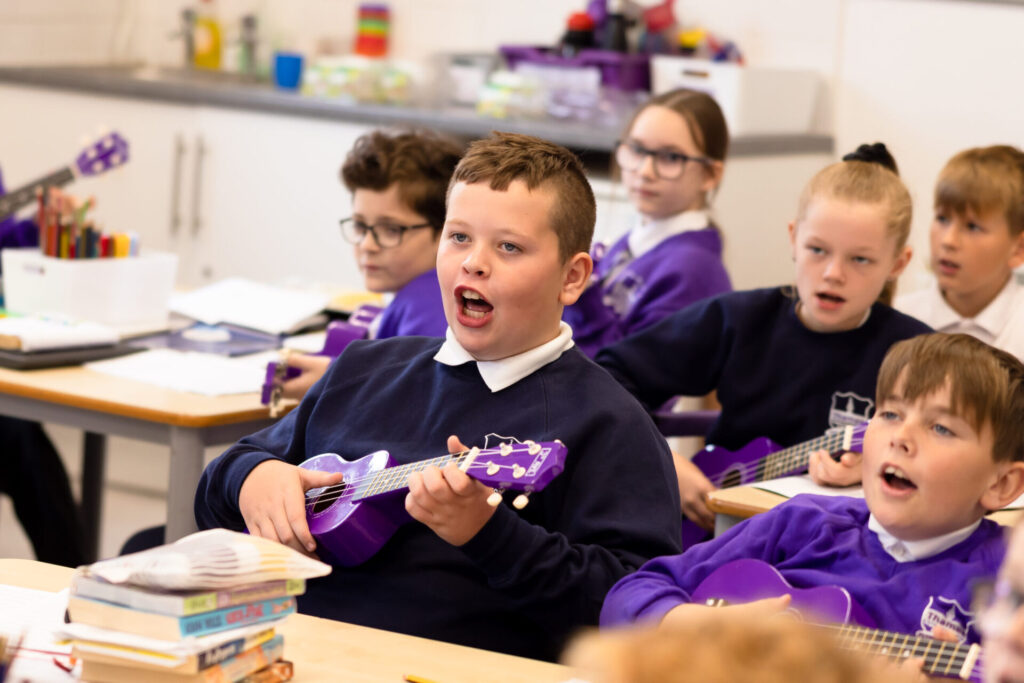
As children progress through the school, they have the opportunity to play a wider variety of instruments, with recorders being taught in Year 3, cornets in Year 4 and ukuleles in Years 5 and 6. Alongside learning how to play instruments, pupils work on reading and writing music notation on a standard stave. This allows them to better discuss and understand the complexities of the music they are listening to – especially in pitch, tempo and dynamics. Over their time in Key Stage Two, the children come to understand the wide variety of reasons music has been composed, including the spiritual and religious elements of music. Wherever possible, any connections to History and Geography are highlighted in order to strengthen schemas through making links. Pupils are introduced to music from different cultures and traditions to better discuss the similarities and differences of known works. Alongside this, pupils continue to use Charanga to better their understanding of the key elements of music and to question how music makes them feel and why.
Impact- what will this look like?
During their time at Thames Primary Academy, learners are introduced to a wide variety of musical styles and opportunities for innovation and creativity. They have time for self-reflection to consider their areas of strength and areas to improve. The integral nature of music and the learner creates an enormously rich palette from which a child may access fundamental abilities such as: achievement, self-confidence, interaction with and awareness of others and self-reflection.
Pupils will be asked to retrieve their growing knowledge of music on a regular basis with weekly quizzes that give pupils the chance to recall the information they have learned. The use of video recording will play an important part in gathering evidence to demonstrate the growing musical capabilities of each child, both when singing and performing and when playing an instrument.
P.E.
P.E. at Thames
‘Intelligence and skill can only function at the peak of their capacity when the body is healthy and strong’
John F. Kennedy
Intent- why do we teach this?
At Thames Primary Academy we aim to ensure our Physical Education curriculum is fully inclusive of every child, empowering each one to enjoy and experience success in the subject in order to develop confidence towards Physical Education and have a positive impact on their future well-being.
Our Physical Education curriculum seeks to ensure that every child becomes physically and mentally skilled in all areas, such as dance, gymnastics and games as they progress through school. Lessons are planned and sequenced into small units so that knowledge is taught in relation to all of our children’s cognitive loads and is built cumulatively over time.
We support children to recognise the importance of Physical Education in developing healthy, active lifestyles and enabling them to become active citizens in their local community. At Thames we educate our pupils about the significance of physical and mental health with our Physical Education offer enabling pupils to access a broad range of opportunities and knowledge that develop the whole child (physically, socially, emotionally and mentally). Our Physical Education offer is designed in a way that promotes the importance of community and how participating in the wider community allows our children to be exposed to additional opportunities and possibilities, both inside and outside of their school life. Communication is a key component within all aspects of sport and therefore we strongly believe in supporting and developing our pupils to become effective communicators and well rounded citizens through Physical Education and our wider curriculum offer.
Opportunities to participate in sport through our wider offer helps build character and embed values such as fairness and respect. In turn, children develop their ability to work both independently and collaboratively, preparing them for the wider community and adult life.
Implementation- What do we teach? What does this look like?
Teachers and external providers reinforce an expectation that all children are capable of achieving high standards in Physical Education in at least two sessions a week. Children are given regular opportunities to access additional physical activities such as lunch clubs and a wide range of after school enrichment clubs. The large majority of children progress through the curriculum content at the same pace. Differentiation is achieved by emphasising deep knowledge and through individual support.
To ensure whole consistency and progression, the school uses the Get Set 4 PE Scheme of Physical Education which is fully aligned with the 2014 National Curriculum. This ensures that there is a detailed, progressive curriculum mapped out across all phases, ensuring continuity and supporting transition.
Early Year Foundation Stage Curriculum
Physical Development in Reception aims to develop the two prime areas of learning with regards to the Early Year Foundation Stage Curriculum. The two main areas are:
- Physical Development
- Personal, Social and Emotional Development
The key focus in all lessons is to develop the children’s fundamental skills, which include, balance, coordination and agility. Children are also taught how to travel into space using a range of speeds, how to control objects and how to use the resources safely.
The curriculum for KS1 and KS2 is designed and divided into four whole child objectives, these are:
- Social
- Emotional
- Thinking
- Physical
Key Stage 1
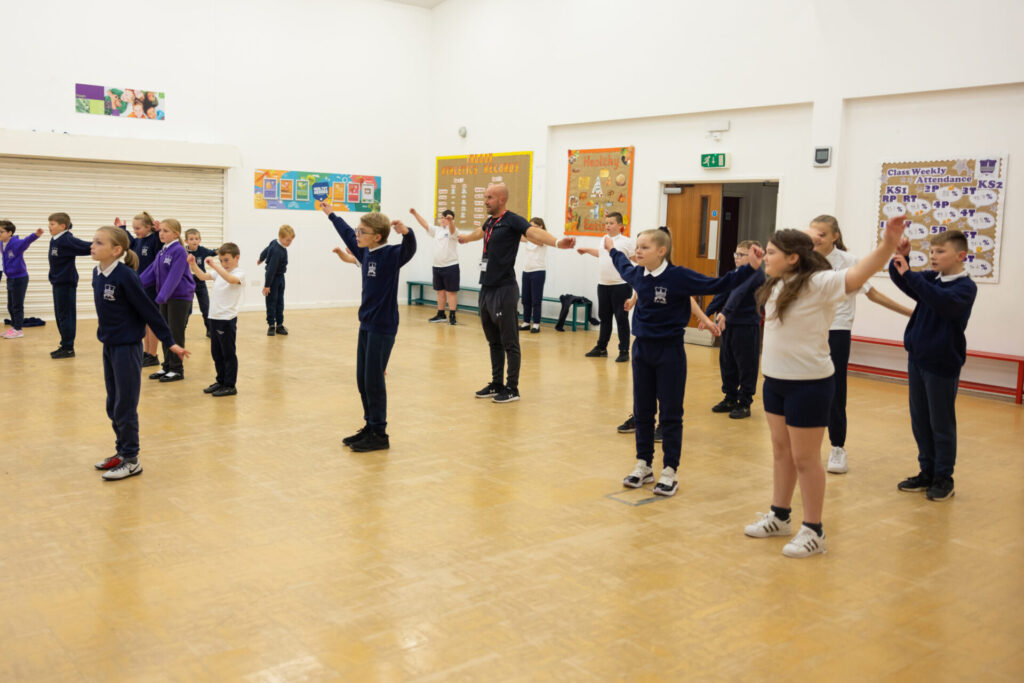
In Key Stage 1 we teach children to master basic skills, such as, running, jumping, throwing and catching and continue to develop the fundamental skills. The children are able to develop these skills through a range of learning opportunities, both independently and with others. The children take part in small competitive games, with the aim of them developing tactics for attacking and defending, whilst also developing adequate levels of communication. The children learn simple dance patterns and are encouraged to use their own creativity to link movements together. Children have the opportunity, through our wider offer, to attend various events, within the school year throughout their time in Key Stage One.
Key Stage 2
In Key Stage 2 we ensure that we continue to apply and develop a broad range of skills, with the children thinking about how they can adapt the skills in different ways. In line with the 2014 National Curriculum the children take part in competitive games, modified where necessary. Although the children take part in competitive games, we encourage them to evaluate their own learning whilst developing sufficient levels of communication. In order to develop individual’s flexibility, strength, technique, control and balance the children will take part in activities, such as, Athletics, Gymnastics and Yoga. Children will continue into Key Stage 2 having the opportunity, through our wider curriculum offer, to attend various events, which are linked directly with the local and wider community. Children in Key Stage 2 will also participate in swimming lessons at the local swimming pool to develop their competence, confidence and proficiency at swimming by the time they leave Thames Primary Academy. Children will learn and understand the importance of water safety, so that they can take their skills and knowledge into the wider community and adult life.
Impact- what will this look like?
At the Thames Primary Academy, we envision our Physical Education curriculum impacting all pupils in the following ways:
- By Year 6, children will have the ability to swim 25 metres independently in a local swimming pool. The children will have a good understanding of water safety.
- Children will extend their knowledge and understanding of a healthy lifestyle and will be exposed to a range of different physical activities throughout the school day to keep active. Participating in these will promote a positive attitude to both physical activities and to the skills that they have learnt through their participation.
- Children will develop a good level of physical fitness, which will result in the ability to remain active for a sustained period of time.
- When working independently and within a team, children will develop the knowledge of how to evaluate and improve both theirs and their team’s performances. Whilst showing respect for individuals, teams, officials and coaches.
Our Physical Education curriculum is tailored to impact greatly on our children’s ability to acquire the knowledge, skills and understanding needed to make appropriate choices about their physical and future well-being. We have embedded this through the use of the Get set 4 PE Scheme of Physical Education.
Swimming Lessons at Thames Primary Academy
Thames Primary Academy work with Blackpool Borough Council to provide swimming lessons for our Year 5 cohort each year. The year group receive lessons each Friday, from fully qualified and DBS checked instructors, throughout the full academic year at Palatine Swimming Pool.
Here are the results from the 2024 cohort:
What percentage of your current Year 6 cohort can swim competently, confidently and proficiently over a distance of at least 25 metres?
44%
A number of our children begin swimming lessons in year 5 with no previous swimming experiences. This results in them spending the majority of their time in the smaller pool, which is only 14m in length.
We have also had a limit of 30 minutes in the swimming facilities per week – a total of just 18 hours across the year. This has also been reduced due to facility closures and holidays.
What percentage of your current Year 6 cohort can use a range of strokes effectively [for example, front crawl, backstroke, and breaststroke]?
51%
As above.
What percentage of your current Year 6 cohort are able to perform safe self-rescue in different water-based situations?
36%
With 44% being able to swim competently and 51% being able to use a range of strokes, many of the children find self-rescue difficult.
Personal Development
Personal Development at Thames
“The only person you are destined to become is the person you decide to be” – Ralph Waldo Emerson
Intent- why do we teach this?
At Thames Primary Academy, we intend to provide a whole school PSHE (personal, social, health and economic) curriculum that will equip pupils with the knowledge, understanding, attitudes, values and skills they need to manage their lives, now and in the future. Our PSHE curriculum helps pupils to stay healthy – both physically and emotionally – safe and prepared for life – and work – in modern Britain. The PSHE curriculum will also help our pupils to reach their potential as individuals and within their community by making informed decisions about the endless possibilities they will come across in their lives. We want our pupils to be able to articulate and communicate their emotions and feelings and be able to reflect on and clarify their own values and attitudes so they can develop their own sense of identity and be able to be resilient when facing difficulties
Implementation- What do we teach? What does this look like?
At Thames Primary Academy, we deliver PSHE weekly by following the on-line scheme SCARF, which is a spiral, progressive, whole school approach that provides a comprehensive scheme of work from the Early Years Foundation Stage to Year 6 covering all of the DfE’s statutory requirements for Relationships Education and Health Education and PSHE Association’s Programmes of Study content for Key Stages 1 and 2. Although there are always occasions where teachers may feel it necessary to teach PSHE as a result of an issue that arose in their own class. SCARF stands for Safety, Caring, Achievement, Resilience and Friendship and is divided into six half termly units. The units are divided into the following themes:
Me and my relationships
Valuing difference
Keeping myself safe
Rights and responsibilities
Being my best
Growing and changing
Children explore these units year-on-year, building a toolkit of strategies and knowledge which they apply in scenario-based lessons, giving them the opportunity to ask questions and practise the skills in a safe and caring environment. Individual lessons are tailored to suit the needs of the children in our school in keeping with the objectives. Every teacher has access to SCARF online resources.
Impact- what will this look like?
Thames Primary Academy pupils will:
Have a sense of purpose
Value self and others
Form relationships
Handle setbacks and disagreements
Make and act on informed decisions
Communicate effectively
Work with others
Respond to challenge
Be an active partner in their own learning
Be active citizens within the local community
Explore issues related to living in a democratic society
Become healthy and fulfilled individuals
Teachers use SCARF Pre and Post Unit assessments and summative assessments to review how the children are progressing within each unit of PSHE learning. Thames Primary Academy’s PSHE curriculum will give our pupils a solid foundation for whatever challenging opportunities lie ahead, so they can face a world full of uncertainty with hope.
R.E.
R.E. at Thames
“Faith makes all things possible, love makes all things easy,”
D.L. Moody.
Intent- why do we teach this?
At Thames Primary Academy we aim to ensure our Religious Education curriculum is fully inclusive of every child, empowering each one to enjoy and become inquisitive in the subject. This deeper knowledge and empathy, enables them to develop a positive and confident attitude, so that they communicate effectively with people from all faith backgrounds.
The key aims for religious education are reflected in the two core strands:
- Learning about religion and belief
- Learning from religion and belief
These recognise the diversity of the UK and encompass the local, national and wider global community.
We engage pupils in an enquiry approach where they can develop an understanding and appreciation for the expression of beliefs, cultural practices and influence of principle religions and worldviews.
At Thames, we provide a broad and balanced curriculum which embraces spiritual, moral, social and cultural development. This presents a range of possibilities for pupils to reflect and develop their own worldview. Community cohesion and high standards of achievement are promoted. We intend for children to develop positive attitudes and values and to reflect on and relate their learning in RE to their own experiences; all contributing to well rounded individuals with a healthy mindset. Children will understand the relevance of RE in today’s modern world and how it affects our lives.
Religious Education at Thames is given the same status as other subjects in the curriculum. It follows the requirement of the Education Reform Act 1988 that the syllabus “shall reflect the fact the religious traditions in Great Britain, are in the main Christian, whilst taking into account the teaching and practices of the other principal religions represented in Great Britain.”
Implementation- What do we teach? What does this look like?
Our RE curriculum provides a wide breadth of study, incorporating all the content of the National Curriculum. It is an enquiry-based approach with reference to the Lancashire Agreed Syllabus for Religious Education 2021. It is carefully designed and sequenced to ensure a clear progression in the development of knowledge and skills to maximise learning for all pupils.
It is essential that as pupils learn, they will develop an RE schema which is organised in a meaningful way so that they learn and remember more. They are encouraged to make connections in their learning through the knowledge and concepts that they are taught.
Making connections and highlighting them throughout the teaching of the breadth to help the knowledge to ‘stick’ in the pupil’s memory is a crucial part of learning. We use retrieval practice to aid pupils in storing knowledge in their long-term memories. We endeavour to build knowledge with an awareness of cognitive loads, and so we start from what children already know, and build on this using a carefully planned progression. Lessons and new topics begin with a review of prior learning to support pupils in assimilating new knowledge with previously introduced concepts.
RE includes a distinct body of knowledge that will enable all pupils to make effective progress in achieving RE learning outcomes, through a high quality, coherent and progressive scheme of work. Opportunities are maximised to contribute to the cross-curricular dimensions of the wider curriculum. Pupils will be exposed to issues of right and wrong, good and evil, conflict and justice.
Enrichment opportunities include:
- Exploring controversial issues in the modern world
- Working with local communities who promote the beliefs taught in lessons
- Learning outside the classroom by participating in educational visits
- Themed days and assemblies which celebrate different beliefs
- Encouraging pupils to deploy their skills and reflect on questions regarding truth and morality
- Promoting debate and dialogue of pupils within their local community
With our younger children we begin with their own experiences based around themes, e.g. friendship, and build on these with examples of stories both about faith leaders and from faith leaders. As children develop in their understanding, we begin to focus learning on the principles of major world faith groups. We then return to key themes, building a deeper understanding of how these have become established principles for religious groups and by finding threads of similarity. A bank of both generic and specific vocabulary is gradually introduced at pertinent points throughout the scheme and revisited regularly as understanding grows and develops.
There are 6 key strands that thread through the RE curriculum. They are:
| Beliefs and teachings (from various religions)Understanding the key teachings of various religions. |
| Rituals, ceremonies and lifestyles (from various religions)Exploring the day-to-day lives and practices of various religions. |
| How beliefs are expressedUnderstanding how books, scriptures, symbols, art and readings convey beliefs. |
| Time to reflect and personal growthShowing an appreciation for how religion plays an important role in people’s lives. Exploring identity and who we are. |
| Values (in your own life and others’ lives)Showing an appreciation for what people value and how it is an important aspect of their life. Making sense of right and wrong and choices we make. |
To improve understanding of each topic, several methods of teaching are deployed including but not limited to:
- Storytelling
- Adult-led activities
- Child initiated activities
- Debating
- Dramatic performance
To improve communication and language in the classroom, teachers will encourage pupils’:
- Organisation, clarification and sequencing of thoughts, feelings and ideas
- Development of their own narratives in relation to the stories they hear in lessons
- Exploration of their feelings and emotions towards set narratives
We ensure all pupils can access our teaching by planning support for those that need it in the form of differentiated resources or additional teacher support.
Impact- what will this look like?
Our aim is for attainment in line with national expectations. We envisage that pupils will leave us, able to talk about religions in the UK and the wider world with confidence, understanding the links between and beyond them. They will be able to understand key elements of each faith’s approach towards worship and how they express those beliefs in response to the wider world. They will be confident to form their own opinions about beliefs and completely understand that each individual has the right to follow their own beliefs.
Assessment allows for evidence of a growing body of knowledge and vocabulary. Teachers use a range of formative assessment techniques as well as making summative assessment judgements at the end of a unit of work.
Should you have religious reasons for wanting to withdraw your child from RE lessons, please contact Mrs. Allison (Headteacher) by emailing jallison@thames.atctrust.org.uk
Science
Science at Thames
“In Science…we can inspire something….every discovery, however small, is a permanent gain”
– Pierre Curie to Marie, 1894
Intent- why do we teach this?
At Thames Primary Academy, our Science curriculum aims to equip children with the foundations for understanding the world around them. Entwined throughout the Science curriculum are our school drivers – Possibilities, Community, Communication and Healthy Advocates. The children will encounter people who have made significant contributions to the field of science over time, understanding that science has been a quest for understanding for many years, and will continue to be so in the future. The children will build a body of key foundational science knowledge as they work through the curriculum, asking questions, communicating their findings and developing a sense of curiosity about the world around us. Woven through the Science curriculum we will explore the possibilities for their futures, introducing them to the notion that their job might not have been invented yet!
Implementation- What do we teach? What does this look like?
Following the primary Science curriculum our children have an introduction to fascinating content such as the inner workings of the human body including how to keep ourselves healthy, animals and the environments they live in, plants and their features, forces in nature, what lies beyond the visible and what lies beyond the planet we live on. Over time their knowledge will deepen, moving from recognising and naming parts of the human body to understanding how our muscles work, how our blood moves around our body and how our nervous system helps us to interact with the world.
Pupils are encouraged to use the knowledge they learn in Science and apply it to investigations that test a theory or set out to answer a question. Gathering information, recording data, graphing data and interpreting findings are all essential skills that pupils will apply to new contexts as they work through the curriculum. Enquiries include observing over time, pattern seeking, identifying, classifying and grouping, comparative and fair testing and researching using secondary sources. Scientific enquiries provide children with a wealth of opportunities, but first and foremost they will help to deepen understanding of the nature, processes and methods of science as a discipline and how it differs from other subjects they are studying. The children will gain an understanding of the purpose and uses of science both today and in the future.
Throughout the science curriculum, children are taught that scientific discoveries have been made since time began around the world. The children learn about the work of scientists such as Lewis Howard Latimer, who invented the carbon filament that allowed Edison’s lightbulb to light up the world. They learn that the people who have contributed to science, from Ancient Baghdad to Ancient Rome and beyond, are diverse and many voices make up the story of science.
Impact- what will this look like?
Our Science curriculum builds knowledge incrementally. The children have multiple opportunities to secure and build on their knowledge and understanding as subject content is revisited at points throughout the curriculum. This helps our children to master the knowledge and concepts whilst building up an extended specialist vocabulary. This incremental approach helps teachers to identify knowledge gaps and look back at previous content if they need to close gaps in knowledge or understanding. Our curriculum enables children to understand the important role that science plays in the sustainability of life on earth. We want children following this curriculum to be equipped to go forth into their secondary education with curiosity, passion and a desire for discovery.